
Laser Profilometers in Quality Control

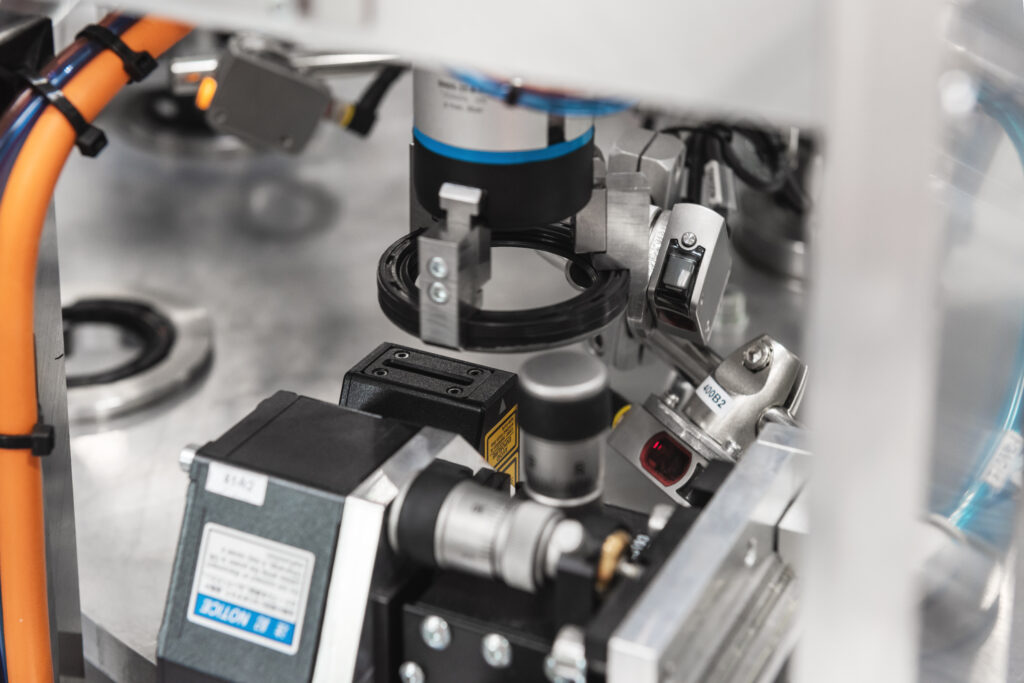
A laser profilometer is a high-precision tool that enables the inspection of microscopic irregularities and surface textures of components. At Smart Automation, we have the expertise to leverage this technology effectively. One prime example is our project involving a robotic quality control station designed for inspecting seals within the automotive industry.
When is it worth implementing a profilometer?
The application of a profilometer makes sense wherever the geometry of a component determines its functionality. We do not limit ourselves to a single industry; we implement this technology wherever flawless repeatability is paramount.
Unlike standard sensors, this device is not restricted to single-point measurement. It collects height data across the entire width of the laser beam. As a result, using just one sensor, we are able to instantaneously obtain a full 2D or 3D profile, simultaneously verifying height differences, widths, and the inclination angles of the components.
Key Benefits
A laser profilometer provides hard numerical data. It is an extremely high-precision tool. In the event a problem is detected, it will provide the exact deviation, for instance, 0.02 inches. This allows the client to collect data for trend analysis. If we observe that components are drifting from the established master template, it serves as a signal that it is time to service the machine before it begins producing waste.
Laser Profilometer – Programming
At Smart Automation, we know that the hardware is just the beginning. Buying an advanced sensor is one thing, but making sure it makes the right decision on the production line is an entirely different challenge. Our team of programmers and engineers has the expertise to “process” this data. A laser profilometer generates a massive point cloud that must be filtered and interpreted in real-time. Our job is to synchronize the robot’s movement with the measurement and send a clear signal to the PLC.
The video demonstrates the result of such integration. The O-ring scanning process for the automotive industry begins with an operator placing the seals on a belt conveyor. From there, the first manipulator transfers them to a buffer, and another places them directly onto the rotary table, where the core process begins. First, the seal is cleaned with deionized air blow-off, and then the robot equipped with the profilometer takes over. The system scans both the inner and outer sides of the product, finally automatically separating the finished seals into good (OK) and defective (NOK).
We have recently completed another project utilizing a laser profilometer. We will be sharing the results of this work with you soon!
Are you looking to implement automation in your company? Contact us today! Our engineering team will analyze your needs and help you find the perfect solution.
📞 + 48 723 040 377
📧 biuro@smartautomation.pl
